Redefining Leadership Through Social Performance

This year is not about statements of intent, it’s about decisive leadership that positions organisations for resilience, competitiveness and long-term value by focusing on purpose.

As 2026 dawns, businesses face a strategic inflection point.
The operating environment is volatile, stakeholder expectations are rising, and the boundaries between commercial performance and social value are dissolving.
The World Economic Forum’s Annual Meeting in Davos has wrapped up. And ahead of the meeting, the Forum published the Global Risks Report 2026. It showed extreme weather events dropped from second down to fourth place in the ranking this year - not because they are any less urgent a risk, but because geoeconomic fragmentation and societal polarization have become more pressing.
Speaking at the Forum, Christine Lagarde, President of the European Central Bank warned that
"we are heading for real trouble" if we don't pay attention to the distribution of wealth and the disparity that is getting "deeper and bigger".
Adecco Group CEO, Denis Machuel, in a separate session also noted,
“If we want peaceful societies, we have to ensure social cohesion."
Leaders recognise the challenges and more importantly take action to bridge this divide through business. This year is not about statements of intent, it’s about decisive leadership that positions organisations for resilience, competitiveness and long-term value by focusing on purpose.
Re‑anchor in purpose as a strategic asset
Purpose is no longer a marketing narrative. It is a performance driver. In a world of geopolitical instability, economic pressure and social fragmentation, purpose provides clarity, alignment and trust. It guides decision making.
For business leaders, the task in 2026 is to ensure purpose is embedded in strategy, capital allocation, procurement, culture and leadership expectations. Purpose should shape how the organisation grows, how it invests and how it shows up in the market.
Adopt practical idealism as competitive advantage
Vision without execution is noise. But execution without vision is incrementalism.
Successful leaders in 2026 are those who pair ambition with discipline. They are the ones that envisions a more resilient, inclusive and competitive economy, and then build the pathways to get there.
This is practical idealism: bold direction anchored in executable steps.
Organisations need to firstly set clear ambition for social performance, creating social value for people – employees, suppliers, customers and communities – alongside financial performance.
Then backing it with governance, measurement, incentives and investment. It means moving beyond pilots and into enterprise‑wide integration.
Create strategic inflection points inside your business
Transformation happens through targeted interventions that shift expectations, capital flows and norms. There are four levers of social performance that can be value drivers when these levers are treated as part of core business strategy, not peripheral initiatives:
- Your people: building fairer and more inclusive workplaces to attract and retain talent.
- Your supply chain: using existing spend to deliver commercial value and social outcomes.
- Your customers: exploring more ethical, affordable or accessible products and services, that build your brand.
- Your community: corporate volunteering, donations, and partnering with certified social enterprises that combine commercial discipline with social impact.
These are not philanthropic gestures. They are strategic tools that strengthen supply chain resilience, mitigate risk, build community trust, unlock innovation and new value pools.
Changing the way things are done
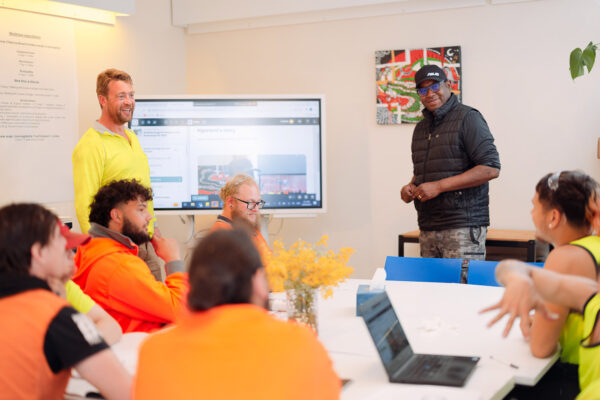
In 2023, John Holland not only delivered the Hobsons Bay Main Project, but they also created an inclusive environment where more than half the workers delivering one of Melbourne’s biggest wastewater projects are women.
According to a report from Infrastructure Australia, the construction industry has the lowest levels of female participation of any industry at 12%, despite being one of the country’s largest employers.
John Holland achieved gender parity with the project team through successful workplace employment partnerships with certified social enterprises, CareerSeekers and Multicultural Consulting Services and other agencies. They focused on executing a recruitment strategy that creates a gender and culturally diverse workplace, tailoring roles to inspire individuals and proactively working to create opportunities and pathways for disadvantaged women.
For Columbian migrant Maria, her career flourished from junior to site engineer and recognised nationally in the business for her outstanding work.
“The team celebrates differences, promotes collaboration and goes above and beyond to recognise achievements. As a new migrant it was challenging, but the project has helped open doors and motivated me to continue growing.”
John Holland chief executive Joe Barr said tackling the under-representation of women in the industry would
“give us a more secure workforce for the future (and) make the industry better, with proven benefits to performance and innovation”.
The project was featured in the Herald Sun and John Holland won the 2024 Social Traders “S” in ESG Frontrunner Award.
Recognise the business case and act on it
Many executives still think of social performance as complex, non-core or disconnected from financial outcomes. Under regulatory pressure and rising social‑washing risks, social performance is often framed as a compliance burden rather than a value driver.
This mindset is outdated and strategically dangerous.
It fails to account for intensifying systemic risks: inequality, climate disruption, resource constraints and declining social cohesion. These forces directly affect supply chains, workforce stability, operating costs and long-term market resilience.
It also ignores emerging competitive dynamics. As the global economy transitions, new markets and customer expectations are forming. Early movers are already capturing advantage.
A Forbes study identified three barriers to sustainability adoption: geopolitical uncertainty, economic volatility and difficulty measuring ROI. The common thread is clear. Many leaders still don’t see sustainability as revenue generating.
But this misperception creates opportunity. Businesses that integrate social performance into core strategy – recognising it as a driver of innovation, differentiation, and long-term value – will lead the next wave of competitive advantage.
In 2026, social performance is a business strategy issue.

The Bridge Inc
The market is shifting, lead with courage and optimism
Employees expect it.
Customers reward it.
Investors want it.
Communities monitor it.
Social performance is becoming a competitive advantage, a talent magnet, a risk mitigator and a contributor to enterprise value. Businesses that lead on this front are strengthening their organisation’s resilience and relevance.
The work is challenging. Economic pressure and political volatility can make social value feel discretionary. But if the work feels heavy, it’s because it matters. Businesses are operating in a new norm — where innovation, leadership and impact intersect.
The leaders who succeed in 2026 and beyond will be those who stay the course, even when times are tough.
We are in the ‘messy middle’ of economic and social transition. It requires courage to lead ahead of the curve, and optimism to sustain momentum.
Optimism is not naïve. It’s a performance resource. It fuels teams, strengthens culture and keeps organisations aligned to purpose.
Social performance: The new mandate
This year, businesses must treat social performance as core business and move from pilots to enterprise-wide integration. It’s a year to redefine leadership.
Not by choosing between profit and purpose, but by recognising that the future belongs to those who deliver both.
Find out how Social Traders can help your business enhance your social performance.
You might also like
 Sector News
Case Studies
Leading through inclusion: The partnership transforming diverse and inclusive workforce
Sector News
Case Studies
Leading through inclusion: The partnership transforming diverse and inclusive workforce
What began as a modest commercial arrangement between CPB Contractors and CareerSeekers is now a strategic, values‑aligned workforce initiative.
 Sector News
Best practice
From e‑waste to empowerment: A game‑changing approach
Sector News
Best practice
From e‑waste to empowerment: A game‑changing approach
WV Technologies setting a new benchmark for what purpose-driven business can achieve in Australia.
 Sector News
Driving social performance and ethical business practices further
Sector News
Driving social performance and ethical business practices further
Social Traders partners with The Freedom Hub to make social performance, business as usual.